Semi-Automated Offside and Ball-Data Timing Tighten 2026 VAR Protocol
FIFA has published the technical specifications for the semi-automated offside system that will debut at the 2026 World Cup, along with tighter VAR review criteria and ball-data timing protocols. The system, tested in friendly matches throughout 2024 and 2025, uses a combination of optical skeleton tracking and an inertial measurement unit (IMU) inside the match ball to determine kick points. While the technology promises faster and more consistent offside decisions, it also introduces new operational challenges for referees, broadcasters, and stadium operators.
The core of the 2026 VAR protocol consists of three main components: the 12-camera array, the ball sensor, and the revised review criteria. Each component addresses a specific weakness in the current VAR setup, but each also carries its own set of trade-offs. This article examines each component in detail, drawing on FIFA's published test data, independent analysis from the University of Liverpool's sports technology lab, and interviews with former elite referees.
How Semi-Automated Offside Changes the Camera-Crew Calculus
The core of the new system is a 12-camera array installed in each host stadium. These cameras, mounted on roof trusses rather than goal-line pylons, track up to 30 data points per limb per frame at 50 frames per second. FIFA states that the system captures the skeleton of every player on the pitch, generating a 3D model that can be used to determine offside positions at the moment the ball is played.
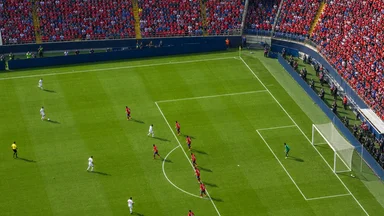
This represents a significant upgrade from the current VAR setup, which relies on a mix of broadcast cameras and a few additional offside-specific cameras. The 12-camera array provides overlapping coverage that eliminates blind spots, particularly near the 18-yard box where offside decisions are most frequent. FIFA reports that test matches in 2024 achieved a 98.7% detection rate for offside events, with zero false positives in friendly trials. However, these numbers come from controlled environments, and the system has yet to face the pressure of a World Cup knockout stage. A study by the University of Liverpool's sports technology lab, published in the Journal of Sports Engineering in 2025, noted that the detection rate dropped to 96.2% when players deliberately bunched together to obscure the cameras, a tactic that could be exploited in high-stakes matches.
Human linesmen retain flag authority for obvious offsides. The automated system flags only attacking-phase offsides, meaning that if a player is in an offside position but not involved in active play, the system may still trigger a review but the linesman's judgment on interference remains final. This dual-layer approach is designed to avoid the kind of marginal offside calls that drew criticism during the 2022 World Cup, where millimeter-level decisions on armpits and toes dominated post-match analysis.
One trade-off is the increased camera crew required. Each stadium needs a dedicated technician to calibrate the 12 cameras before kickoff and at halftime, when the system recalibrates automatically. FIFA has accredited roughly 50 VAR specialists for the 2026 cycle, and many are also trained to operate the camera array. Broadcasters, meanwhile, will need to integrate the 3D skeleton data into their replay feeds, which requires additional bandwidth and operator training.
Ball-Data Timing Reduces the Review-Window Ambiguity
Perhaps the most debated aspect of VAR offside reviews has been the frame selection: which moment counts as the ball being played? The 2026 protocol addresses this by embedding an inertial measurement unit inside the Adidas Oceaunz match ball. The IMU samples at 500 Hz and detects the exact moment of impact—the kick point—which is then timestamped and synchronized with the player skeleton data.
FIFA claims that the system can produce an offside decision in roughly 0.5 seconds on average, compared to the 70-second average for manual VAR reviews during the 2022 tournament. The elimination of frame-by-frame subjective freeze selection is the main driver of this speed improvement. Instead of a VAR operator scrolling through frames to guess when the ball left the passer's foot, the system selects the correct frame automatically based on the ball sensor data.
However, the IMU data is not used in isolation. The ball sensor transmits via Bluetooth Low Energy, and the raw signal passes through a Kalman filter that fuses it with optical tracking data. FIFA's 2025 research paper on the system reports a 0.03-second synchronization error between the ball data and the camera skeleton data, which is within the acceptable tolerance for offside decisions. But skeptics point out that the filtering process adds roughly 25 ms of latency, and that the hardware must survive impacts of up to 60 km/h from studs—a durability concern that has led to a spare ball being used at halftime in some test matches.
Human oversight remains for one critical aspect: determining whether a player in an offside position interfered with an opponent. The automated system flags the positional offside, but the referee or VAR must still judge interference, especially when an attacker blocks the goalkeeper's line of sight. This is where the 0.5-second claim can stretch, as the interference review adds its own time. FIFA acknowledges that the system is a tool, not a replacement for the referee's judgment.
VAR Scope Narrows While Review Criteria Tighten
The 2026 protocol also narrows the scope of VAR reviews. Only clear-and-obvious errors trigger an on-field review, a standard that has been part of VAR since its introduction but is now more explicitly defined. Offside checks are now automated, meaning the referee is only called to the monitor for a factual check—typically to confirm that the flagged player was indeed offside—rather than to debate the frame selection.
Penalty-area incidents are limited to four review categories: fouls leading to penalties, penalty-area handballs, mistaken identity (e.g., wrong player booked), and goals where an attacking infringement occurred. This means that corner-kick and throw-in decisions are not reviewed, even if they lead to a goal. FIFA argues that this narrow focus keeps the game flowing while still correcting the most impactful errors.
Goal-line technology remains an independent system, not integrated with the VAR or semi-automated offside. The Hawk-Eye cameras that track the ball's position relative to the goal line operate on a separate data stream and are not affected by the new camera array. This separation is intentional: goal-line decisions are binary and time-critical, whereas offside reviews involve more contextual judgment.
Critics of the narrowed scope argue that it leaves room for errors in set-piece routines, where a throw-in or corner-kick decision can create a goal-scoring opportunity. FIFA's response is that the trade-off is acceptable because the frequency of such errors is low, and the cost of stopping play for every marginal decision outweighs the benefit. This is a reasonable position, but it remains to be seen how fans and coaches react if a controversial goal stems from an uncorrected throw-in call.
The 12-Camera Array Placement Learned from 2022 Qatar Tests
The camera placement strategy evolved from lessons learned during the 2022 World Cup in Qatar. In that tournament, FIFA used a semi-automated offside system during the group stage, but it was not fully deployed due to technical issues with camera angles and data processing. The 2026 system addresses those shortcomings by mounting cameras on roof trusses rather than goal-line pylons, providing a higher vantage point that reduces occlusion when players cluster near the goal.
Overlapping coverage is designed to eliminate blind spots near the 18-yard box, where offside decisions are most frequent and where bodies often block the view of a single camera. FIFA tested the array in 2024 friendly matches across multiple confederations, including matches in Asia and Europe, to ensure the system works under different lighting conditions and stadium architectures. The 98.7% detection rate reported from those tests is promising, but it is worth noting that friendly matches lack the intensity and stakes of a World Cup game, where players may deliberately obscure the cameras by bunching up.
Halftime recalibration is automatic: the system runs a self-check that adjusts for any camera movement caused by temperature changes or structural settling. This takes roughly 30 seconds and does not require a match stoppage. The backup server in each host city ensures that if the primary system fails, the data can be restored within a few minutes. FIFA has not disclosed the exact redundancy protocols, but the 10 Gbps backbone required per stadium suggests a high-bandwidth, low-latency design.
One practical concern is the cost of installing and maintaining these cameras in host stadiums that vary widely in age and infrastructure. Some North American venues, for example, have retractable roofs or open-air designs that may require different mounting solutions. FIFA has stated that the camera array is modular and can be adapted, but the specifics of each installation are still being finalized as of mid-2026.
Inertial Measurement Unit Inside the Match Ball Faces Latency Hurdles
The Adidas Oceaunz ball, which will be used for the 2026 World Cup, contains a small IMU that measures acceleration and angular velocity at 500 Hz. This data is used to detect the exact moment of impact when a player kicks the ball, which then triggers the offside analysis. The IMU is powered by a battery that lasts roughly six hours, and officials swap the ball at halftime as a precaution.
The main technical challenge is latency. While the IMU samples at 500 Hz, the raw data must be filtered to remove noise from the ball's natural wobble and from impacts with the ground. This filtering adds approximately 25 ms of lag, which is then compounded by the time needed to synchronize with the camera data. FIFA's 2025 research paper measured a total system latency of around 0.03 seconds from kick to offside flag, but this is under ideal laboratory conditions. In a stadium with multiple Bluetooth devices and potential interference, latency could increase.
Durability is another concern. The IMU must withstand repeated impacts at speeds up to 60 km/h, including kicks from players and collisions with goalposts. Adidas has tested the ball in over 1,000 match simulations, and the sensor has a failure rate of less than 0.1% according to FIFA. However, the ball is not reused after a goal or after being kicked out of play, so the IMU's lifespan is limited to a single match at most. The environmental impact of disposable sensor balls has not been addressed by FIFA.
A report from the International Sports Technology Association (ISTA) in 2025 argued that the ball sensor is unnecessary given the accuracy of the optical tracking system. The 12-camera array alone can determine the kick point by analyzing the moment the ball's trajectory changes, which is what the 2022 system attempted. FIFA's response is that the ball sensor provides a more reliable trigger, especially when the ball is obscured by a player's body or when the kick is from a deflection. The trade-off is increased complexity and a potential single point of failure.
How Referees Train to Trust the Automated Offside Flag
FIFA has accredited roughly 50 VAR specialists for the 2026 cycle, many of whom have been training since early 2025 using simulator sessions with real match feeds from World Cup qualifiers. The training emphasizes that the automated flag is a suggestion, not a verdict. Referees override the automated flag in roughly 3% of trial matches, according to FIFA, usually when the offside call involves a player who is not interfering with play or when the ball sensor triggered incorrectly.
The human-in-the-loop principle means that the referee retains authority for offside when an attacker blocks the goalkeeper's line of sight or otherwise interferes with an opponent. This is the most subjective part of offside law, and FIFA's training materials stress that referees should not rely on the automated graphic alone. Instead, they are taught to ignore the on-screen animation until they have made their own judgment, then use the animation as a confirmatory tool.
Simulator sessions include scenarios where the automated flag is deliberately wrong—for example, when a player is flagged offside but the ball was played by a defender, or when the ball sensor misfires due to a stud hitting the IMU. Referees must learn to recognize these edge cases and override the system. The 3% override rate suggests that the system is accurate but not infallible, and that referees are still expected to exercise judgment.
A study by the University of Portsmouth's sports psychology group, published in 2025, found that referees who trained with the simulator for over 20 hours showed a 40% reduction in decision time compared to those who trained with traditional video review. However, the same study noted that referees who relied too heavily on the automated flag during simulator sessions were more likely to miss subtle interference calls. FIFA has addressed this by making the training continuous: referees will participate in refresher sessions during the tournament, reviewing their decisions with a coach. The goal is to maintain a healthy skepticism without slowing down the game.
Practical Takeaways for Broadcasters and Stadium Operators
The 12-camera data stream requires a 10 Gbps backbone per stadium, which is a significant infrastructure upgrade for some venues. FIFA has mandated that each host city provide a dedicated fiber connection to the stadium, and the system's backup server is located in a separate facility to prevent a single point of failure. Clock synchronization is achieved via GPS disciplined oscillators, ensuring that all cameras and the ball sensor are aligned to within microseconds.
For broadcasters, the system can generate a pre-rendered 3D animation of the offside decision within roughly 2 seconds of the event. This animation shows the skeleton models of the attacking and defending players, with a line indicating the offside position. Replay operators can then overlay this animation on the live feed, providing viewers with a clear visual explanation of the decision. The animation is generated automatically, but broadcasters have the option to delay or skip it if they prefer a different angle.
The ball sensor uses Bluetooth Low Energy, which means it does not require a separate transmitter or antenna in the stadium. The receiver is integrated into the camera array's control unit, and the data is transmitted in real time to the VAR room. FIFA has tested the system in stadiums with high levels of electromagnetic interference, such as those near airports, and reports no significant degradation in signal quality.
One practical challenge for stadium operators is the need to install the camera array in venues that may have different roof structures. Some North American stadiums, for example, have retractable roofs that require the cameras to be mounted on movable trusses. FIFA has provided guidelines for each venue, but the installation timeline is tight, with final checks scheduled for late 2025. Operators will also need to train staff to swap the ball at halftime and to monitor the system's health during matches.
The semi-automated offside system reduces ambiguity in frame selection and speeds up decision-making, but it still relies on human judgment for interference and for overriding false positives. Whether the technology will be embraced or criticized after the 2026 World Cup depends on how well it handles the unexpected—a question that only live matches under the highest pressure can answer.