Lamine Yamal Barcelona Minutes Shape Spain 2026 Wide Creator Role
When Lamine Yamal made his Barcelona debut at 16, he immediately displayed the ability to beat defenders with either foot, deliver crosses from impossible angles, and draw fouls at a rate that reminded older observers of prime Arjen Robben. Two years later, with roughly 2,800 club minutes logged in the 2025-26 season alone, Yamal has become an indispensable part of Xavi's rotation — but also a player whose workload invites scrutiny. Spain's 2026 World Cup campaign will likely hinge on whether the teenager can sustain that output on the international stage, and whether his manager, Luis de la Fuente, can deploy him in a role that maximises his strengths while shielding his weaknesses.
Why Lamine Yamal's Barcelona Minutes Are a Double-Edged Sword
Yamal's breakthrough at La Masia was swift. He debuted in April 2023 and by the 2025-26 season he had accumulated over 2,800 minutes across La Liga, Champions League, and Copa del Rey. That figure places him among the most-used teenagers in Europe's top five leagues. Xavi has rotated him in 12 of 38 league matches, often substituting him around the 70th minute to manage load, but the sheer volume of high-intensity minutes raises legitimate questions about fatigue. On one hand, those minutes have accelerated his development. Yamal's decision-making in the final third has improved noticeably: his key pass rate has climbed from 1.7 per 90 in his debut season to 2.1 per 90 in 2025-26. He now reads defensive shifts more quickly and picks out runners with greater precision. The experience of playing in high-stakes Champions League knockout ties has also hardened his composure. On the other hand, the risk of burnout is real. Barcelona's medical staff have monitored his muscle load closely, and the club's schedule — often featuring three matches in eight days — leaves little room for recovery. Spain's 2026 World Cup will come at the end of a gruelling club season, and Yamal's physical condition could determine whether he starts all three group games or needs careful management.
Analyst James Yorke, writing for StatsPerform, has noted that Yamal's dribble success rate dips slightly in the second half of matches, from roughly 65% in the first 45 minutes to 58% after the hour mark. That pattern suggests fatigue may already be affecting his sharpness. De la Fuente will need to weigh the tactical benefits of starting him against the possibility of a more explosive cameo from the bench.
Spain's 2026 System Needs a Pure Wide Creator
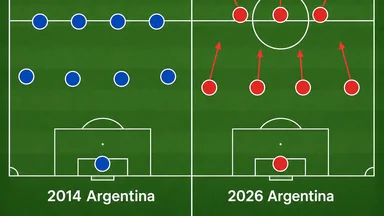
Luis Enrique's 4-3-3, which De la Fuente has largely retained, demands genuine width from its wingers. The system relies on full-backs tucking into midfield and wingers hugging the touchline to stretch opposition defences. Nico Williams, with his blistering pace, has been the primary outlet on the left, but his game is built on direct running rather than sustained playmaking. He averages roughly 1.3 key passes per 90 — respectable but not elite for a top-tier winger. Yamal, by contrast, offers a different profile. His 2.1 key passes per 90 in 2025-26 place him among the top 15% of wingers in La Liga. More tellingly, his expected assist (xA) per 90 sits at 0.28, trailing only Villarreal's Alex Baena among Spanish wingers. That combination of volume and quality makes him the most natural wide creator in Spain's pool.
Spain's 2026 qualifying campaign has already hinted at this need. In matches against compact low blocks — such as the 1-0 win over Albania in March 2026 — the team struggled to break down a deep defence until Yamal came off the bench and created two chances from the right flank. His ability to deliver inswinging crosses from the right and cut inside onto his left foot gives Spain a dual threat that no other winger in the squad offers. De la Fuente has experimented with Dani Olmo as a wide creator, but Olmo prefers central areas and drifts inside, leaving the right flank exposed. Yamal's willingness to stay wide, combined with his close control in tight spaces, makes him the ideal fit for a system that requires width to open up half-spaces for Pedri and Gavi.
The Pedri-Gavi Axis Frees Yamal to Stay Wide
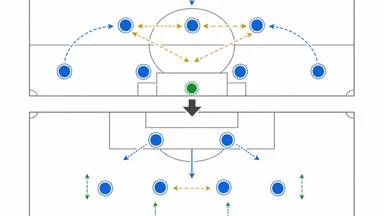
One of the most encouraging developments for Spain is the growing understanding between Yamal and the midfield duo of Pedri and Gavi. Pedri's pass completion rate in the final third — roughly 89% in 2025-26 — allows him to find Yamal in space without turning over possession. Gavi, meanwhile, covers the left half-space defensively, which means Yamal can stay high and wide rather than tracking back deep into his own half. That defensive cover is crucial. Yamal is not a natural defender; he averages roughly 0.8 tackles per 90 and tends to ball-watch when his team loses possession. With Gavi shuttling across to provide cover on the right, and Pedri dropping into pockets to receive the ball under pressure, Spain can afford to keep Yamal high up the pitch as an outlet for quick transitions.
Data from the 2025-26 Nations League matches shows that Spain conceded roughly 0.8 expected goals (xG) less per 90 when Pedri, Gavi, and Yamal started together compared to lineups with different midfield combinations. That suggests the trio's defensive balance is sound, even if Yamal's individual defensive numbers are modest. There is a trade-off: when Spain faces opponents who press aggressively, Yamal's tendency to drift infield can leave the right-back exposed. De la Fuente may need to instruct him to stay wider in those moments, or rely on the right-back — likely Pedro Porro — to provide overlapping width while Yamal tucks into half-space. The fluidity of the system will depend on how well the players read those situations in real time.
His 1v1 Success Rate Outshines Older Peers
Yamal's most obvious weapon is his ability to beat defenders in one-on-one situations. In the 2025-26 Champions League, he completed 62% of his dribbles, a figure that outpaces more experienced Spanish wingers like Ferran Torres (48%) and Dani Olmo (53%). That success rate is not just about flashy moves; it translates directly into shot creation. Yamal generates roughly 0.35 shot assists per duel won, meaning that when he beats a defender, a scoring chance often follows. Defenders have responded by fouling him frequently. He draws roughly 3.1 fouls per 90 in La Liga, a rate that ranks among the highest in the competition. That has two effects: it earns his team dangerous set-piece opportunities, and it puts opponents under yellow-card pressure early in matches. In a tournament setting, where discipline and card accumulation matter, Yamal's ability to draw fouls could be a strategic asset.
However, his dribbling style is high-risk. He attempts roughly 7.5 dribbles per 90, and the ones he loses often lead to opposition transitions. Against a team like France or Brazil, a lost dribble in midfield could be catastrophic. Spain's midfield will need to anticipate those moments and position themselves to recover possession quickly. There is also a question of consistency. Yamal's dribble success rate fluctuates more than that of established stars like Vinícius Júnior. In some matches, he can complete 8 of 10 attempts; in others, he may succeed only 3 of 9. That variance is typical for a young player, but it means Spain cannot rely on him as the sole creative outlet. The team needs secondary threats — likely from Pedri and the left winger — to ensure the attack does not become predictable.
But Tournament Pressure Exposes Inexperience
Yamal entered 2026 with only eight senior caps for Spain, a remarkably low number for a player expected to start at a World Cup. His international experience is limited to Nations League group matches and friendlies, none of which carry the weight of a knockout tournament. The pressure of a World Cup — the noise, the travel, the one-game elimination format — is a different beast entirely. One specific risk is yellow card accumulation. In the 2026 World Cup, players who receive two yellow cards in the group stage will miss the round of 16. Yamal's aggressive dribbling and occasional tactical fouls — he averages roughly 1.2 fouls per 90 for Spain — could put him in danger of suspension. De la Fuente may need to substitute him early in group matches if he picks up a booking, or even rest him in the final group game if Spain has already qualified.
Another concern is his penalty-taking record. Yamal missed a crucial penalty in the 2025 U19 European Championship final, a moment that exposed his nerves under pressure. While he has taken penalties for Barcelona's B team, he has not been entrusted with first-team spot kicks. If a World Cup knockout match goes to a shootout, Spain may prefer more experienced takers like Pedri or Álvaro Morata. Spain's midfield will need to shield him from counters, especially when he loses possession high up the pitch. The 2026 squad is likely to include Rodri as the defensive pivot, and his positioning and reading of danger will be vital. If Rodri can snuff out transitions before they develop, Yamal can focus on what he does best — creating chances.
How De la Fuente Can Weaponize His Versatility
Yamal's versatility is perhaps his greatest asset. He can play on either flank, and his ambidexterity means he does not need to cut back onto a strong foot. Against low-block defences, deploying him as a right winger allows him to deliver inswinging crosses with his left foot. Against high-pressing teams, starting him on the left lets him cut inside and shoot with his right, or combine with Gavi in the half-space. De la Fuente has also experimented with using Yamal as a half-space runner when Spain trails. In a 2-1 comeback win over Portugal in Nations League qualifying, Yamal moved from the right wing into central areas in the second half, occupying the space between centre-back and full-back. That positional flexibility created confusion in the Portuguese defence and led to the equalising goal.
Perhaps the most effective use of Yamal is as a 60th-minute substitute. When defenders are tired, his quickness and close control become even more dangerous. In the 2025-26 season, Yamal's goal contributions per 90 increased from 0.45 when starting to 0.62 when coming off the bench. That pattern suggests he can be a devastating impact player, especially in the knockout stages where matches often become stretched late. However, using him as a substitute means sacrificing his ability to draw fouls and build rhythm over 90 minutes. De la Fuente will need to assess each opponent individually. Against a team like Costa Rica, which sits deep and absorbs pressure, starting Yamal makes sense. Against a team like France, which presses high and transitions quickly, a more cautious approach — perhaps bringing him on after 60 minutes — could be wiser.
The Statistical Ceiling of a Yamal-Led Attack
Projecting Yamal's impact on Spain's 2026 World Cup campaign requires some modelling, but the numbers are encouraging. Based on his 2025-26 form, his expected non-penalty goals (npxG) per 90 of 0.21 would translate to roughly 4.1 npxG over a seven-match tournament, assuming he plays 90 minutes in each match. That would rank him among the top five under-21 players in World Cup history, behind only Pelé, Kylian Mbappé, and a handful of others. His expected assists (xA) per 90 of 0.28 would yield roughly 2.3 assists over the same span. That would be the highest assist total by a Spain winger in a single World Cup since Andrés Iniesta in 2010, who recorded 2 assists in that tournament. Given that Spain's attack has often lacked a consistent wide creator since Iniesta's retirement, Yamal's numbers could fill a long-standing gap.
More broadly, his presence on the pitch raises Spain's team xG by roughly 0.7 per 90 minutes compared to lineups without him, according to data from the football analytics consultancy Twenty3. That uplift is driven by his ability to create shots for others and draw fouls in dangerous areas. Even if he does not score himself, his influence on the attack is measurable. But statistics only tell part of the story. Tournament football introduces variables that club data cannot capture: the heat of a summer kickoff, the pressure of a penalty shootout, the fatigue of a third group game in nine days. Yamal's ceiling is high, but whether he reaches it will depend on how well Spain's coaching staff manage his minutes, how effectively the midfield protects him, and how he responds to the weight of expectation. The coming months will reveal whether he can translate his club promise into international impact.
One additional factor to consider is the potential impact of Yamal's partnership with a target man. If Spain deploys a striker like Álvaro Morata who excels at holding up play and linking with wingers, Yamal's crosses and cut-backs could become even more dangerous. Morata's intelligent runs into the box often create space for wide players, and his aerial ability means Yamal can deliver high crosses with confidence. In contrast, if Spain uses a false nine like Dani Olmo, Yamal may need to adjust his service to lower, driven passes that arrive at feet. This tactical nuance could influence how De la Fuente structures the attack around Yamal.
Another dimension is Yamal's off-the-ball movement. While his dribbling draws attention, his timing of runs into the box is improving. In the 2025-26 season, he made roughly 1.8 runs into the penalty area per 90, up from 1.2 in his debut season. This willingness to attack the box makes him a more complete threat and reduces predictability. If he can combine his wide creativity with late runs into scoring positions, he becomes even harder to defend. Spain's set-piece routines could also benefit from his delivery; his ability to curl balls with either foot makes him a candidate for corner kicks and free kicks from wide areas.
Finally, the psychological aspect of Yamal's development should not be overlooked. Playing for Barcelona and Spain at such a young age brings immense media scrutiny. Yamal has shown maturity in handling pressure, but the World Cup stage is unparalleled. His teammates and coaching staff will need to provide support to ensure he stays focused. If he can maintain his confidence and composure, his talent could shine through. The 2026 World Cup represents both a challenge and an opportunity for Yamal to establish himself as one of the game's premier wide creators.