Scaloni 2026 Argentina Shifts Build-Up to Rotation Patterns Without Messi
Lionel Scaloni faces a challenge few national team managers ever confront: how to replace the irreplaceable. Argentina's 2022 World Cup triumph was built around Lionel Messi's 13 goal involvements in 8 matches—8 scored, 5 assisted. But by the time the 2026 tournament rolls around, Messi will be 38. Scaloni has spent the intervening years methodically dismantling the dependency, constructing a system that rotates players and responsibilities rather than funneling everything through one genius.
The Messi Dependency That Defined 2022
Argentina's 2022 campaign was statistically lopsided. Messi averaged roughly 6.5 progressive passes per game and created about 3.2 chances per 90 minutes—numbers no other player on the squad approached. When Argentina needed a goal, the ball went to Messi. When they needed to slow a game down, Messi held possession. The system was effective but fragile: if Messi had been injured, the entire tactical edifice would have crumbled.
Scaloni recognized this vulnerability as early as 2023. In post-tournament interviews, he spoke about the need to “distribute the creative load” across multiple players. The first experiments came in friendly matches later that year, where Messi was rested. Argentina drew 0-0 with a South American opponent and lost to an African side—results that underscored the gap.
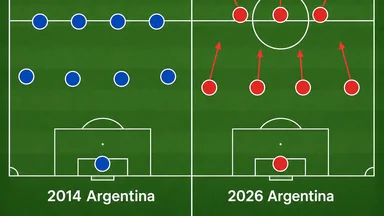
By early 2024, Scaloni had shifted his approach. Instead of trying to clone Messi's role, he re-engineered the team's build-up to rely on positional rotations. Full-backs began inverting into midfield. Center-backs split wider. The goalkeeper started sweeping. The idea was to create numerical superiority in central areas without needing a single elite dribbler to unlock defenses.
The data from 2024-2025 friendlies suggests the plan is working. Argentina posted an 8-2-0 record in matches where Messi did not start, with an average possession of roughly 62% and an expected goal (xG) differential of plus 1.4 per game. Not spectacular, but stable—and sustainable over a tournament.
Scaloni's Tactical Blueprint: From 4-3-3 to Fluid 4-4-2
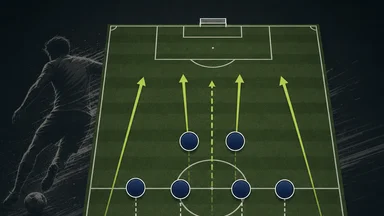
Scaloni's base formation remains a 4-3-3, but it shifts into a fluid 4-4-2 when defending. The key innovation is the role of the full-backs. Nahuel Molina and Nicolas Tagliafico—or their deputies—are instructed to push high and wide in possession, effectively turning the 4-3-3 into a 2-3-5 attacking shape. Without the ball, they tuck inside to form a compact block.
Center-backs Cristian Romero and Nicolas Otamendi (or German Pezzella) split wide during build-up, with the goalkeeper—Emiliano Martinez—often acting as a third center-back. This creates a 3-2-5 structure that allows Argentina to bypass the first line of pressure with short passes rather than long balls.
The midfield trio of Enzo Fernandez, Alexis Mac Allister, and Rodrigo De Paul forms a triangle that rotates constantly. Fernandez drops deep to receive from the center-backs; Mac Allister pushes higher to combine with the forwards; De Paul shuttles between boxes. In the 2022 system, Messi often dropped into the space between midfield and defense to initiate attacks. Now that responsibility falls to the midfielders collectively.
Scaloni has also experimented with a 4-4-2 diamond in certain matches, particularly against teams that press high. In this shape, Mac Allister occupies the tip of the diamond, with Fernandez and De Paul as the interior midfielders, and Leandro Paredes or Guido Rodriguez as the base. The diamond allows Argentina to create a 4v3 overload in central midfield, which helps them progress the ball through congested areas.
Build-Up Phase: Central Triangles vs. Wide Rotations
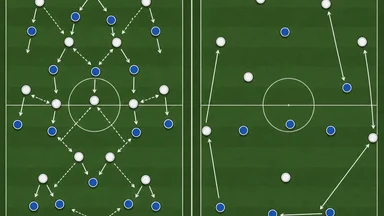
The build-up phase is where Scaloni's rotation patterns are most visible. Argentina typically starts with a 4-3-3, but within seconds of the goalkeeper receiving the ball, the shape transforms. One full-back inverts into midfield, forming a 3-2 base. The two center-backs split wide, and the goalkeeper steps up to the edge of the box.
From this 3-2 structure, Argentina aims to create a central triangle involving Enzo Fernandez, a center-back, and the inverted full-back. This triangle acts as a passing hub, allowing them to escape pressure and switch play to the opposite flank. In 2022, Messi would often drop into this space to receive and turn. Now, Fernandez or Mac Allister fulfills that role.
Against Brazil in a 2024 friendly, Argentina recorded 71% possession and completed roughly 650 passes—about 200 more than their opponents. The majority of those passes were in the middle third, suggesting a deliberate strategy to control the game through possession rather than riskier vertical passes. The final third entries were still relatively low (around 30), but Argentina created 1.8 xG, indicating quality over quantity.
One limitation of this approach is that it can become predictable. Opponents have started to press Argentina's center-backs aggressively, forcing them to play longer passes. Scaloni has responded by instructing his goalkeeper to occasionally bypass the build-up with direct balls to Julian Alvarez, who holds up play and brings midfielders into the game. This hybrid approach—short build-up with occasional long passes—adds a layer of unpredictability.
A trade-off exists between control and penetration. In a 2025 friendly against a compact Uruguayan defense, Argentina's possession reached 68% but they created only 0.9 xG, struggling to break through. The rotation patterns ensured they didn't lose the ball dangerously, but the lack of a dribbler like Messi meant they couldn't unbalance the defense one-on-one. Scaloni's solution was to introduce Lo Celso as a half-space runner, which improved chance creation in the second half.
Final Third: Álvarez as False Nine and Wing Rotations
Julian Alvarez has emerged as the central figure in Argentina's post-Messi attack. At Manchester City, he played as a second striker or false nine, dropping into midfield to create space for wingers. Scaloni has replicated that role, asking Alvarez to vacate the central striker position and drift into the half-spaces. This drags center-backs out of position and creates room for runners from midfield.
Angel Di Maria, now in his late 30s, remains a key option on the right wing. His ability to cut inside and shoot or cross is unmatched, but Scaloni has reduced his minutes to preserve him for knockout stages. In Di Maria's absence, the manager has tested Alejandro Garnacho as an inverted winger, though the young Manchester United player's decision-making remains inconsistent. In a 2025 friendly against Nigeria, Garnacho completed 4 dribbles but made only 12 passes, highlighting a tendency to hold the ball too long.
Nico Gonzalez provides width on the left, stretching defenses with his pace and direct running. In the 4-3-3, Gonzalez stays wide, while the right winger—Di Maria or Garnacho—inverts. This asymmetry creates a 2-1 overload on the left flank, with the left-back overlapping and the left winger cutting inside.
Giovani Lo Celso has been the most direct replacement for Messi's creative role. When fit, he operates in central pockets between the lines, receiving with his back to goal and turning to play through balls. In a 2025 friendly against France, Lo Celso created 4 chances and completed 3 dribbles in a 2-1 win where Argentina posted 2.3 xG despite Messi's absence. The sample size is small—Lo Celso has been injury-prone—but the evidence is promising. A counter-argument is that Lo Celso's defensive work rate is lower than Messi's was in 2022, which could unbalance the midfield against top opponents.
Another option is Lautaro Martinez, who offers a more traditional striker profile. When Martinez plays as a central striker, Alvarez shifts to the right wing, creating a different dynamic. Martinez's hold-up play and aerial threat add a dimension that Alvarez's false-nine role does not. In a 2024 friendly against a European opponent, Martinez scored a header from a cross, a goal type that is rare in the rotation-based system. Scaloni thus has the flexibility to choose between a false nine and a target man depending on the opposition.
Defensive Rotation: Press Triggers and Compact Shape
Without Messi's defensive contributions—he typically covered around 7-8 km per match in 2022, mostly in the attacking half—Argentina needed to adjust their pressing structure. Scaloni implemented a trigger-based press: the team presses when an opponent plays a backward pass or a sideways pass that travels more than 10 meters. In other situations, they drop into a mid-block.
The compact shape is a 4-4-2, with Alvarez and the right winger forming the first line of pressure. The midfield four condenses to block central passing lanes, forcing opponents wide. Full-backs tuck in, turning the 4-4-2 into a 4-5-1 when necessary. This shape has been effective: in 2024-2025 friendlies, Argentina conceded only 0.8 goals per game on average, with an xGA (expected goals against) of roughly 0.9 per match.
Cristian Romero leads the defensive line with aggressive stepping. His willingness to step out of the backline to intercept passes is both a strength and a risk: when he mistimes, it leaves space behind. Dibu Martinez's sweeper-keeper style mitigates this, as he often starts outside his box to cover through balls.
One counter-argument is that Argentina's defensive numbers have been padded by weak opposition in friendlies. Against top-tier teams like Brazil and France, they conceded 0 and 1 goals respectively, but the quality of chances allowed was higher. In the France match, Les Bleus missed several clear opportunities. Scaloni's system may hold against moderate presses but could be exposed by elite transition teams in the knockout stages. For instance, a fast counter-attacking side like the Netherlands could exploit the space left by inverted full-backs.
Key Friendlies Shaped the System: 2024-2025 Evidence
The 2024-2025 friendly cycle provided the clearest evidence of Scaloni's evolving system. In a June 2024 match against Brazil, Argentina dominated possession (71%) but created only 1.8 xG, scoring once. The match highlighted the team's control but also their lack of incision. Scaloni responded by tweaking the midfield rotation, asking Mac Allister to make more runs into the box.
A March 2025 friendly against France was the most instructive. Without Messi, Argentina used a 4-3-3 that shifted into a 4-4-2 without the ball. The midfield triangle of Fernandez, Mac Allister, and De Paul completed roughly 85% of their passes in the attacking half, and Alvarez dropped deep to link play. The 2-1 win came with 2.3 xG, suggesting the rotation patterns were generating quality chances.
Scaloni used 14 different starting XIs across 2025 friendlies, rotating heavily to test combinations. Some experiments failed: a 3-5-2 shape against a low-block opponent resulted in a 0-0 draw, with Argentina struggling to break through. Others succeeded: a 4-2-3-1 with Lo Celso as a No. 10 produced a 3-0 win against a European mid-tier side.
The overall record—8 wins, 2 draws, 0 losses in friendlies without Messi—is impressive, but friendlies are not World Cup matches. The intensity, pressure, and opposition quality will be higher in 2026. Scaloni's system has passed the preliminary tests, but the real exam is yet to come.
Lineup Flexibility: Four Core Variations for 2026
Scaloni has settled on four core lineup variations for the 2026 tournament. Option A is the 4-3-3 with Alvarez as a false nine, Di Maria on the right, and Gonzalez on the left. This is the most tested shape and likely the first-choice for group stage matches against weaker opponents.
Option B is a 4-4-2 diamond, with Mac Allister at the tip of the diamond behind two strikers—Alvarez and Lautaro Martinez or Julian Alvarez paired with a second forward. This shape sacrifices width for central control, making it suitable against teams that defend in a low block. The diamond can create overloads in central areas but leaves the full-backs exposed to counter-attacks.
Option C is a 3-5-2, with Molina and Tagliafico as wing-backs. This formation provides defensive solidity and allows Argentina to match up against teams with three center-backs. It was used sparingly in friendlies but could be a tactical surprise if Argentina faces a possession-dominant opponent.
Option D is a 4-2-3-1, with Lo Celso as the No. 10 and two holding midfielders behind him. This shape maximizes creativity but sacrifices defensive cover. Scaloni has used it only against weaker sides, but it could be an option if Argentina needs a goal late in a knockout match.
The common thread across all variations is rotation. No player except perhaps Emiliano Martinez has a guaranteed starting spot. Scaloni's selection will depend on the opponent's press, the match state, and player fitness. This flexibility is the system's greatest strength—and its greatest challenge, because it requires every player to understand multiple roles.
Whether this rotation-based approach can replicate the magic of 2022 remains an open question. The evidence from friendlies is encouraging, but the World Cup is a different beast. Scaloni has built a system that does not depend on a single genius. Whether it can win without one is the defining question of Argentina's 2026 campaign.
Potential Weaknesses and Adjustments
Despite the promising data, Scaloni's system has identifiable weaknesses. First, the reliance on full-back inversion can leave the flanks exposed if possession is lost. Against a team like France, which uses wingers who stay wide, Molina's inverted movement could create space for Kylian Mbappe to attack. Scaloni has experimented with asymmetrical full-back roles—one inverts while the other stays wide—to mitigate this risk.
Second, the midfield rotation requires high tactical intelligence. If one player misreads a rotation, gaps appear. In a 2025 friendly against a disciplined opponent, a miscommunication between Fernandez and De Paul led to a counter-attack goal. Scaloni has addressed this through video analysis and drilling patterns in training.
Third, the lack of a consistent goalscorer is a concern. Alvarez, Martinez, and the midfielders share goals, but no one has emerged as a reliable 20-goal-per-season striker at international level. In the 2022 World Cup, Messi scored 8 goals; in 2026, that burden must be distributed. The xG data suggests chances are being created, but finishing is variable. Argentina's conversion rate in friendlies without Messi is about 12%, which is average but not elite.
Scaloni has responded by encouraging midfield runners. Mac Allister, in particular, has been instructed to make late runs into the box, a tactic that yielded 3 goals in 2025 friendlies. De Paul has also added long-range shooting to his game. These adjustments aim to compensate for the absence of a single prolific scorer.
Another potential issue is the depth of the squad. While the starting XI is strong, the bench lacks proven game-changers. Players like Exequiel Palacios, Thiago Almada, and Lucas Ocampos offer versatility but not the same quality as the starters. An injury to a key player like Fernandez or Mac Allister could disrupt the rotation patterns. Scaloni has cross-trained players in multiple positions to build redundancy, but the drop-off in quality is still noticeable.