Metro Expansion Speed and Stadium Access Define 2026 Los Angeles Hub
When the 2026 World Cup kicks off, SoFi Stadium in Inglewood will host eight matches, including a quarterfinal. But the journey from airport to seat—and back—will test Los Angeles's infrastructure, which ranks 47th out of 50 U.S. metro areas for transit accessibility according to the American Society of Civil Engineers. While the venue itself is purpose-built for spectacle, the surrounding transit, lodging, and security networks are scrambling to catch up. The gap between ambition and reality will define how smoothly this hub operates.
Metro Rail Expansion Lags Behind 2026 Match Schedule
LA Metro's K Line, which opened in 2022, currently terminates at Westchester/Veterans, about three miles short of SoFi Stadium. The extension to Inglewood—with a station at Florence Avenue and Hindry Street—is scheduled for completion by late 2025, roughly six months before the tournament. But construction delays are common on LA transit projects; the Crenshaw Line, of which the K Line is part, opened three years behind its original schedule. Even if the extension is ready, only about 40% of fans are expected to use rail for matches, based on Metro's own ridership models for major events. That's well below the 60–70% rail share seen at European World Cup venues. The gap is partly geographic: SoFi sits in a car-centric corridor, and the nearest existing station—Hawthorne/Lennox on the C Line—is a 20-minute bus ride away. Shuttle buses will supplement the 12,000 on-site parking spots, but those shuttles will compete with match-day traffic on the same surface streets. The Crenshaw Line connection, which would link the K Line directly to the C Line and provide a one-seat ride from LAX, remains unconfirmed for the tournament. Metro has not committed to completing the transfer tunnel by 2026, meaning fans from the airport may still need to switch trains at the cramped Willowbrook/Rosa Parks station. Average headways on the K Line are roughly 22 minutes, compared to the 8-minute frequency FIFA typically expects for World Cup transit. Metro has promised to increase service, but the rolling stock and operator capacity are finite. Park-and-ride lots at outlying stations, such as Norwalk and El Segundo, will absorb some demand, but those lots are already near capacity on regular event days. The math suggests that thousands of fans will drive directly to the stadium, regardless of transit improvements. That reality shapes every other logistics decision the city faces.
SoFi Stadium's Modular Design Eases Football-to-Soccer Conversion
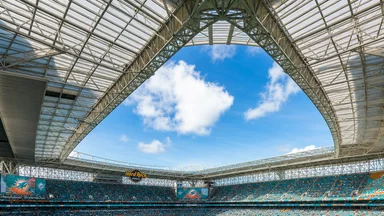
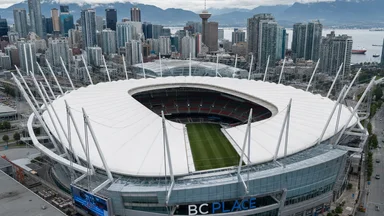
SoFi Stadium was designed primarily for American football and concerts, but its architects included flexibility for soccer. The field width can be reduced from the standard 73 meters to the FIFA-required 68 meters by sliding in temporary seating sections. That conversion also adds roughly 10,000 seats, pushing capacity past 70,000 for World Cup matches—above the 60,000 minimum FIFA requires for group-stage games. The turf installation window is tight: only about 14 days between the last NFL preseason game and the first World Cup match. SoFi uses a natural grass surface grown in pallets, which is stored on-site and swapped in for soccer events. The stadium's retractable roof and cooling system mitigate Southern California's summer heat, but the grass must be kept alive under a translucent panel that reduces direct sunlight. Groundskeepers will need to monitor moisture and temperature hourly during the conversion period. NFL sidelines, normally 6 meters wide, will be expanded to 9 meters to accommodate technical areas, substitution benches, and FIFA's requirement for a 3-meter-wide corridor behind the benches. That means the first row of seats closest to the field will be removed or blocked off, reducing sightlines for some premium ticket holders. The video board, which is the largest in any NFL stadium, can display FIFA graphics and match clock without structural changes, but the control room will need to run a separate overlay system for offside lines and VAR replays. The stadium's modularity also extends to locker rooms. The home and away NFL locker rooms will be subdivided to accommodate four teams on match days, with temporary partitions and additional showers installed. FIFA requires a minimum of 25 individual changing stations per team, which SoFi can meet by repurposing the adjacent practice facility. These conversions are well-rehearsed—SoFi has hosted international friendlies and CONCACAF matches—but the World Cup schedule demands a faster turnaround between events.
Inglewood's Hotel Stock Falls Short of FIFA Booking Targets
Within a five-mile radius of SoFi Stadium, there are only about 3,800 hotel rooms. FIFA requires at least 12,000 rooms for accredited personnel—teams, officials, media, and sponsors—within a reasonable commute. The shortfall has forced organizers to look further afield. Cruise ships docked at the Port of Los Angeles are being chartered as floating hotels, with some offering shuttle service to the stadium. That arrangement is common for Super Bowls, but a month-long tournament requires continuous, not single-weekend, occupancy. Airbnb listings in Inglewood and surrounding neighborhoods have surged roughly 140% since 2023, according to short-term rental data firms. Many of those are apartments and houses rented out by residents who plan to leave during the tournament. However, Los Angeles's strict short-term rental regulations—limiting hosts to 120 days per year—may cap the supply. The city has signaled it will relax enforcement during the World Cup, but the legal framework is unclear. For budget-conscious fans, dormitory-style accommodations at local universities—including Loyola Marymount and UCLA—are being reserved, but those are 30 to 60 minutes away by car. The price disparity will likely push many fans toward downtown Los Angeles, where rooms are cheaper, but the commute adds time and complexity. FIFA's requirement that all accredited personnel have guaranteed rooms within a 90-minute drive has led to hotel contracts as far away as Anaheim and Long Beach. Those locations are 45 to 60 minutes by car in light traffic, but match-day congestion could stretch that to two hours. The league has not yet published its final hotel allocation, but early indications suggest that some team delegations will be housed in Santa Monica and Beverly Hills, 20 to 30 minutes from SoFi under ideal conditions.
Fan Zone at LA Live Competes with Stadium Proximity Needs
FIFA mandates that each host city operate at least one fan zone where ticketless supporters can watch matches on large screens, with food and drink available. Los Angeles's primary fan zone will be at LA Live, the entertainment complex in downtown LA, about 12 miles from SoFi Stadium. The site can hold roughly 25,000 people, but its distance from the venue creates a logistical disconnect: fans who want to watch a match at the stadium cannot easily switch to the fan zone afterward, and vice versa. A second, smaller fan zone has been proposed at Hollywood Park, the mixed-use development adjacent to SoFi Stadium. That site would be more convenient for match-goers but has limited capacity—some estimates place it near 10,000—and its beer garden permits are capped at that number by local regulations. FIFA requires that all fan zones be accessible without a match ticket, which Hollywood Park can satisfy, but the space is also used for pre-match concerts and sponsor activations, creating competition for square footage. The Metro E Line connects downtown LA to Inglewood in roughly 45 minutes, but the station at La Cienega/Jefferson is still a 15-minute walk from LA Live. Shuttle buses will run between the station and the fan zone, but those will share downtown streets with regular traffic. The fan zone at LA Live is also close to the convention center, which will house the FIFA Fan Festival and media headquarters, but that cluster of activities may overwhelm the area's street capacity on match days. Some fan groups have argued that locating the primary fan zone downtown rather than in Inglewood reduces the sense of stadium atmosphere. In previous World Cups, fan zones were often within walking distance of the venue, creating a continuous corridor of activity. Los Angeles's dispersed geography makes that difficult, but the Hollywood Park option could partially bridge the gap if its capacity is expanded. As of late 2024, no expansion plans have been announced.
Traffic Modeling Predicts 90-Minute Post-Match Gridlock
Transportation planners have modeled post-match traffic patterns for SoFi Stadium based on data from NFL games and the 2022 Super Bowl. The primary chokepoints are Century Boulevard and the I-105 freeway, both of which handle north-south traffic through Inglewood. After a full stadium empties, the model predicts average travel times of 90 minutes to clear a two-mile radius. For fans heading to LAX, the three-mile drive could take an hour. LA Metro plans to add roughly 30 extra trains on match days, primarily on the K and C lines, to increase frequency. But the system's capacity is constrained by single-track sections and limited yard space for storing extra cars. The agency has also committed to operating the K Line until 2 a.m. on match nights, later than its usual midnight close. Rideshare drop-off zones have been moved 1.5 miles from the stadium, at designated lots on Manchester Boulevard and Florence Avenue, to reduce congestion at the venue curbside. Fans will need to walk or take a shuttle from those lots to the gate. Parking prices at SoFi Stadium range from roughly $60 for pre-paid economy lots to $200 for premium tailgate spaces. On match days, secondary market prices can double. The stadium has about 12,000 on-site parking spots, but many are reserved for suite holders and VIPs, leaving perhaps 8,000 for general admission. That shortfall pushes cars into surrounding neighborhoods, where residents have complained about illegal parking and blocked driveways during big events. The city has designated permit-only parking zones for the tournament, but enforcement will require additional personnel. Pedestrian-only corridors will be created on Prairie Avenue between the stadium and the K Line station, and on Century Boulevard between the stadium and the Hollywood Park fan zone. These corridors will be closed to vehicles three hours before and two hours after matches. The closures will affect local businesses, which have been offered compensation packages by the organizing committee, but details of those packages have not been made public. The trade-off between fan mobility and neighborhood disruption is a recurring tension in host-city planning.
Security Perimeter Extends Beyond Stadium to Transit Stations
FIFA requires a sterile security zone extending 500 meters from the stadium perimeter. Inside that zone, all vehicles and pedestrians are subject to search, and only accredited persons and ticketed fans are allowed. At SoFi, that zone covers roughly 0.8 square kilometers, including parts of the Hollywood Park development, the adjacent parking lots, and a portion of Century Boulevard. The Los Angeles Police Department has contracted roughly 1,200 off-duty officers for match days, supplementing the 3,000 private security guards hired through Securitas. Security screening will also extend to transit stations. LA Metro platforms at Hawthorne/Lennox and the new Inglewood station will have bag checks and metal detectors, operated by private contractors. Drones will surveil a two-mile radius around SoFi, with a no-fly zone enforced by the FAA. The LAPD's air support unit will also patrol the area. These measures are standard for large events, but the World Cup's duration—nearly a month—requires sustained staffing, which strains both budgets and personnel availability. Inglewood's own police force has been augmented by a grant from the state of California, but the city's infrastructure for handling large crowds is limited. The fire department has conducted tabletop exercises for medical emergencies, including heatstroke and crowd crush, based on lessons from the 2022 Super Bowl. One particular concern is the narrow concourses at SoFi's lower bowl, which can become congested during halftime. FIFA has mandated that all standing areas be replaced with seated zones, but the concourse width is fixed. The security perimeter also affects local residents. Those living within the sterile zone will need to show ID to enter their own homes on match days. The city has distributed passes and set up a hotline for complaints, but the inconvenience is unavoidable. Some residents have voiced concerns about noise and traffic, but the city has emphasized that the World Cup is a one-time event that will bring economic benefits. The tension between security and normalcy is a familiar theme in host cities, and Los Angeles is no exception.
Beyond the immediate perimeter, security extends to the broader transportation network. The LAPD has coordinated with the California Highway Patrol to monitor freeway exits near the stadium for suspicious vehicles. License plate readers have been installed on major routes, and random vehicle inspections will occur at key intersections. These measures are designed to deter potential threats but also add to congestion. The city has also established a joint command center with representatives from the FBI, DHS, and FIFA security, operating 24/7 during the tournament. The center will coordinate responses to any incidents, from medical emergencies to security breaches. One of the biggest challenges is the sheer scale of the event: with eight matches over several weeks, maintaining high alert levels for that duration is unprecedented for Los Angeles. The city has drawn on lessons from the 2028 Olympics planning, but the World Cup's concentrated schedule in a single venue presents unique demands.
Los Angeles's preparation for the 2026 World Cup is a series of unresolved questions: Will the metro extension open on time? Can hotels absorb the surge? Will the traffic plan hold up under real conditions? For a city that prides itself on spectacle, the real test may be less about the show on the field and more about the journey to the seat.